
We’ve all been there. You spend three days writing a custom connector to hook your AI assistant into Salesforce. It works. You celebrate. A week later, the API changes, and it breaks. Meanwhile, your colleague is doing the exact same thing for Slack. And another team is doing it for the internal CRM.
This is the Integration Tax—the endless cycle of building, maintaining, and rebuilding connectors every time you want an AI model to actually do something useful.
In November 2024, Anthropic decided to stop paying this tax. They released the Model Context Protocol (MCP)—an open standard that’s quickly becoming what USB-C did for charging cables.
The N×M Problem
Before we talk about the solution, let’s be clear about the problem.
Say you have 5 AI tools (Claude, ChatGPT, Cursor, your internal agent, etc.) and 10 data sources (Slack, GitHub, Postgres, Google Drive, your proprietary API…). Without a standard, you need 50 custom integrations. Every combination needs its own connector.
Now scale that. Add a new model? Build 10 more connectors. Add a new data source? Build 5 more. The math gets ugly fast.
This isn’t a hypothetical. It’s what enterprises are living through right now. Anthropic called it being “trapped behind information silos and legacy systems.” I call it expensive, boring, and fundamentally unscalable.
Enter MCP: The USB-C Analogy
Remember the drawer full of proprietary chargers? Nokia had one plug. Samsung had another. Apple had three different ones depending on the year. It was chaos.
Then USB-C happened. One port. Universal compatibility. The drawer got emptier.
MCP is the USB-C moment for AI agents.
Instead of N×M integrations, you get N + M. Each AI tool implements the MCP client once. Each data source implements the MCP server once. They all just… work together.
And here’s the kicker: this isn’t an Anthropic-only play. OpenAI and Google have signaled adoption. The open-source community is building servers for everything from Notion to Kubernetes. It’s not a walled garden—it’s a public utility.
How It Works (The 30-Second Version)
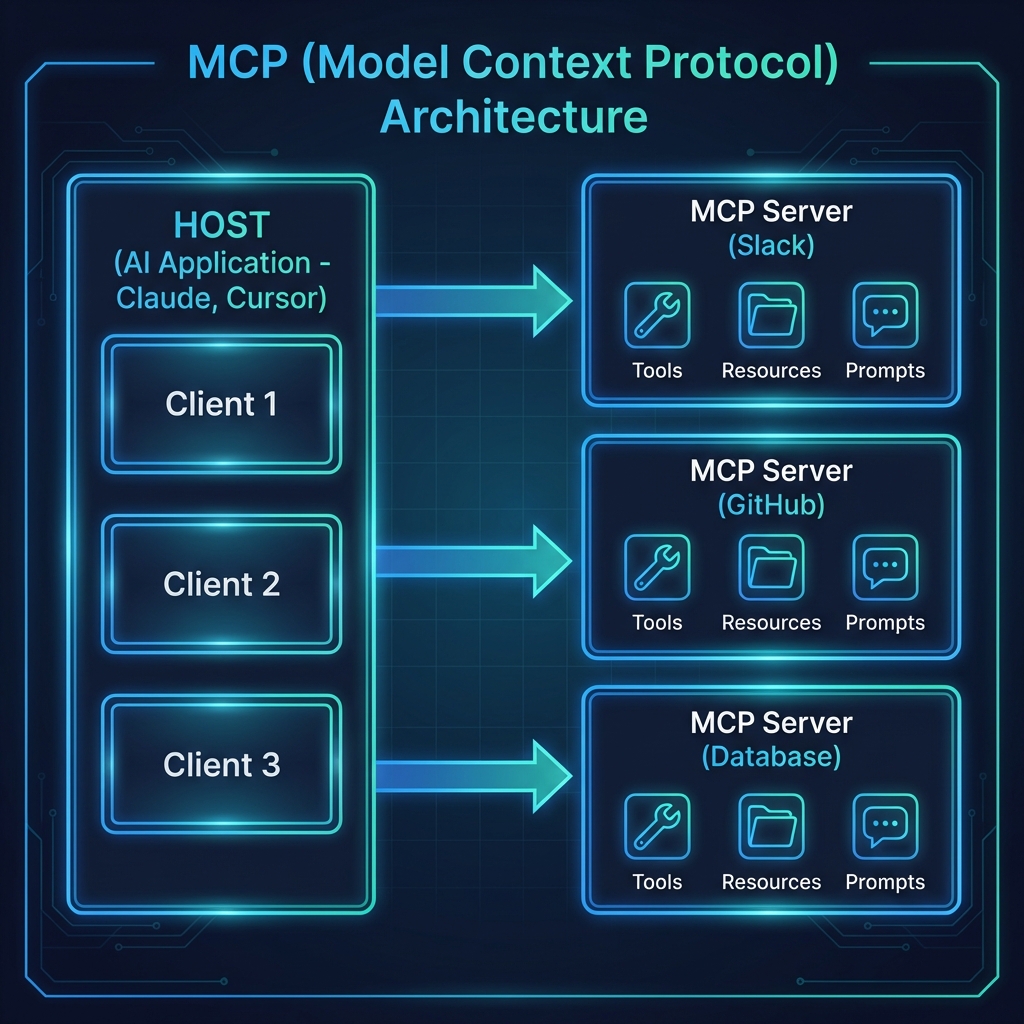
Picture: [MCP Architecture]
MCP has three actors:
| Component | Role |
| Host | The AI application (Claude Desktop, Cursor, your custom agent) |
| Client | The protocol connector inside the Host—translates requests |
| Server | The external capability (Slack, GitHub, your Postgres database) |
When you ask Claude to “check my calendar and book a flight,” here’s what happens:
1. The Host (Claude) asks its Client: “What servers are available?”
2. The Client checks connected MCP Servers and finds a Calendar server and a Travel server.
3. The Host uses Tools from those servers to execute actions.
The Host doesn’t need to know how the Calendar server works. It just asks “what can you do?” and the server responds with a list of capabilities.
The Three Primitives
MCP servers expose three types of capabilities:
| Primitive | What It Does | Example |
| Tools | Execute actions | searchFlights(), sendEmail(), queryDatabase() |
| Resources | Provide data | file:///docs/report.pdf, calendar://events/2024 |
| Prompts | Offer interaction templates | A plan-vacation workflow with structured inputs |
Tools are the “do this” commands—API calls, database queries, file operations.
Resources are the “read this” data sources—files, logs, records, anything with a URI.
Prompts are pre-packaged workflows that guide the AI through multi-step tasks.
A single MCP server might expose all three. A filesystem server gives you Tools to create files, Resources to read them, and maybe a Prompt for “organize this folder.”
The Ecosystem Is Already Here
This isn’t vaporware. The ecosystem is moving fast.
Early Adopters:
- Block (formerly Square) is building agentic systems with MCP
- Apollo has integrated it into their workflows
- Zed, Replit, Codeium, Sourcegraph—the AI coding tools are all in
SDKs in 10 Languages:
TypeScript, Python, Go, Kotlin, Swift, Java, C#, Ruby, Rust, PHP
100+ Third-Party Integrations:
Slack, GitHub, Notion, Postgres, Google Drive, Figma, Salesforce, Sentry, Puppeteer… the list keeps growing.
There’s even an [MCP Registry](https://registry.modelcontextprotocol.io/) where you can browse published servers.
Why Should You Care?
If you’re a developer:
Build one MCP server for your internal API. Suddenly, every MCP-compatible AI tool can use it—Claude, Cursor, whatever comes next. No more rewriting connectors.
If you’re running a company:
MCP means no vendor lock-in. If you switch from Claude to GPT-5 to Gemini, your data layer stays the same. The Integration Tax drops to near-zero.
If you’re a user:
Your AI assistant finally has context. It can read your files, check your calendar, and take actions—without you copy-pasting information between apps.
What’s Next
This is the first post in a series on MCP. Here’s what’s coming:
1. ✅ This Post: Why MCP matters
2. Blog 2: Under the Hood—deep dive into architecture, transports, and the protocol spec
3. Blog 3: Build Your First MCP Server in 20 minutes (Python/TypeScript)
4. Blog 4: MCP in the Wild—real-world patterns and use cases
5. Blog 5: Security, OAuth, and the agentic future
The Integration Tax era is ending. The question isn’t if MCP becomes the standard—it’s how fast you get on board.
—
Want to explore? Start at [modelcontextprotocol.io](https://modelcontextprotocol.io) or browse the [MCP Registry](https://registry.modelcontextprotocol.io/).
– Satyajeet Shukla
AI Strategist & Solutions Architect
 TheTechDialogue
Practical insights to help you grow your Skill/Business faster.